EDC SuDS Selector Introduction

Add a description


An Introduction to SuDS

In the modern landscape of urban development, Sustainable Drainage Systems (SuDS) offers a compelling opportunity for developers to align environmental responsibility with a commercially beneficial drainage strategy. Far beyond a regulatory requirement, SuDS represent a strategic design approach that integrates water management into the fabric of development and if integrated from first principles, can deliver advantages in construction, placemaking and sales.

From first principles, SuDS can reduce the need for costly underground drainage infrastructure by mimicking natural hydrological processes. By managing surface water on-site through permeable surfaces, swales, rain gardens, and attenuation features, developers could significantly lower capital expenditure on traditional pipe-to-tank or pipe-to-pond systems and reduce ongoing maintenance costs. These systems are often simpler to install, require less excavation, and can be phased in line with construction schedules, improving cash flow and project flexibility.

SuDS replicate natural processes to control and absorb rainwater where it lands, either on or just below the surface. They also provide a range of additional benefits that can enhance the overall value of a development. These include:

  • Biodiversity

  • Amenity

  • Water Quality

  • Air Quality

  • Noise pollution

  • Cooling (Urban Heat Island Effect - UHIE)

  • Urban Greening

  • Shade from trees

SuDS can enhance value and marketability. Developments that incorporate green infrastructure and visible water features tend to attract higher buyer interest due to their aesthetic appeal, biodiversity benefits, and improved public spaces. In commercial and residential contexts alike, SuDS contribute to placemaking, creating environments that are not only functional but also desirable.

Critically, SuDS can also mitigate flood risk, reducing potential liabilities and insurance premiums. By controlling runoff and improving climate resilience, developers can future-proof neighbourhoods against climate-related disruptions and extreme weather. This proactive approach supports compliance with planning legislation, guidance and environmental standards, streamlining approvals and simplifying the built environment.

This guidance outlines how SuDS can be effectively integrated into developments in Ebbsfleet Garden City, drawing on local design frameworks and national best practice. It aims to equip developers with the knowledge to make informed, financially sound decisions that support a sustainable development and promote long-term asset value.


The Four Pillars of Sustainable Drainage

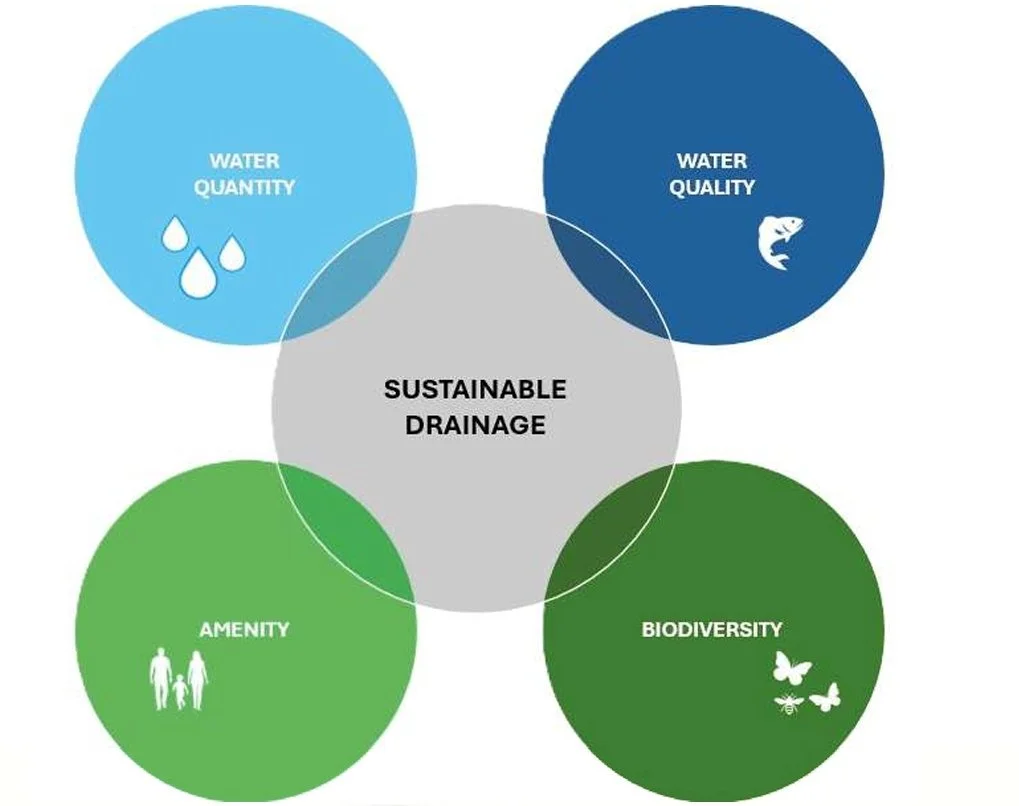
Sustainable Drainage Systems are developed to follow the following principles defined by CIRIA.

Water quantity - focuses on managing runoff to reduce flood risk and prevent erosion by slowing, storing, re-using and infiltrating rainwater.

Water quality - ensures that pollutants are filtered out through natural processes before water re-enters the environment, protecting ecosystems and public health.

Amenity - emphasises the creation of attractive, multifunctional spaces that enhance the urban environment and improve wellbeing for residents and visitors.

Biodiversity - supports ecological resilience by integrating green infrastructure that provides habitats for wildlife and strengthens the natural character of developments.

Together, these pillars promote a holistic, sustainable approach to urban water management that delivers environmental, social, and economic benefits.

Sustainable Drainage Do’s and Don’ts

Do

SuDS First - Pipes Last - You must ensure SuDS are integral to the earliest stages of Masterplanning as part of a Landscape Led process and considered before conventional drainage solutions.

Right Team at the Right Time - You should utilise an experienced SuDS Engineer to plan the drainage system collaborating with the Landscape Architect, Ecologist and Development Design Team.

As much as you can, as soon as you can - You should ensure sustainable drainage follows a treatment train of localised interventions coupled together to slow the flow of water on its journey to its end destination ensuring the first 5mm of any rainfall is contained within site.

Right SuDS in the Right Place - Plan intelligently and introduce the correct SuDS intervention for the right scenario.

Installation to handover - Duty of Care - Do ensure maintenance is carried out particularly in relation to irrigation of planting, contamination from highway runoff and blockages with construction materials, prior to handover and/or adoption. [

Below-ground landscaping - ensure drawing coordination by showing 'below-ground landscaping' on engineering and utilities drawings (e.g. soil cells for SuDS-enabled tree pits).

Decompact Soil - All soils on site must be handled in line with the Construction Code of Practice for the Sustainable Use of Soils on Construction Sites. The next page focuses on the importance of minimising the effects of compaction when installing SuDS systems.

Don't

Pipe to Pond - You must not channel run-off through conventional drainage to an end of pipe attenuation feature. This avoids all SuDS intervention opportunities and increases risk at the end of the system, resulting in large and over engineered attenuation solutions.

Wrong SuDS in the Wrong Place - You must not design a conventional drainage system and subsequently add SuDS as an additional element. This practice results in avoidable cost and duplicated engineering effort and may compromise the hydraulic and environmental performance of the SuDS. Pumped solutions should only be considered as a last effort after considering all 'positive' methods.


Soil and Ground Conditions

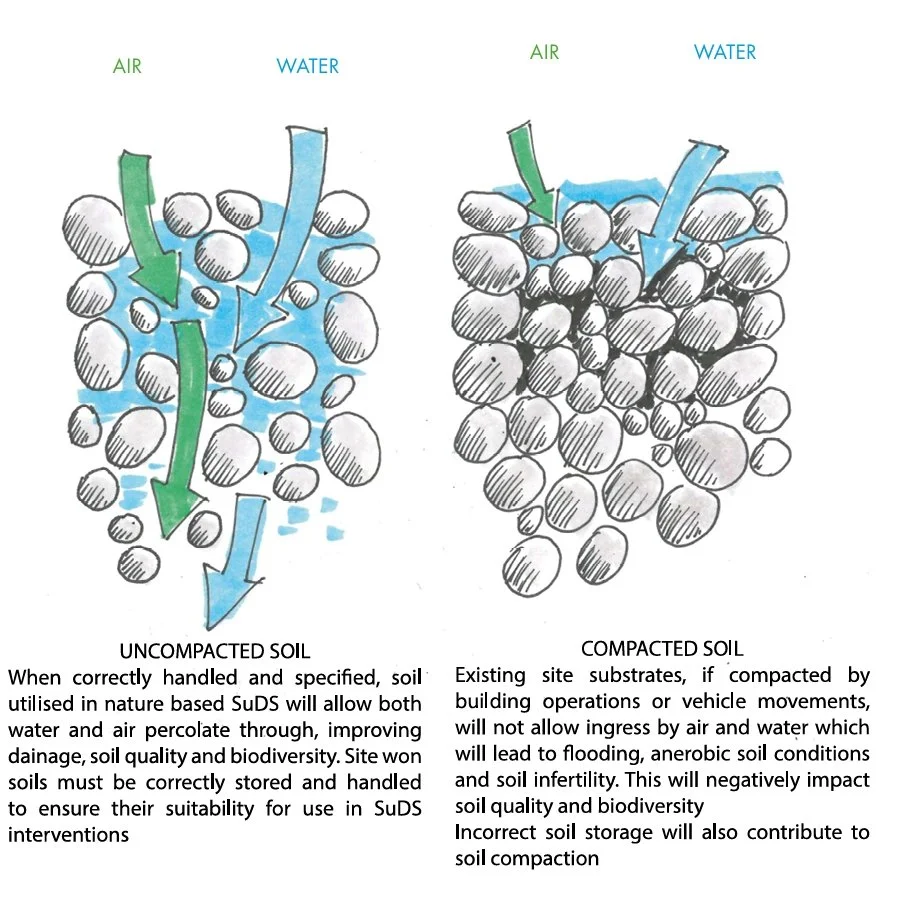
Ground compaction can significantly reduce the effectiveness of SuDS. Site movements of heavy machinery and repeated trafficking compress soil particles, reducing pore space and permeability. This means that meaning rainfall cannot soak into the ground as intended, and instead generates higher volumes of surface runoff.

Compaction also diminishes soil's ability to store water, slowing down natural attenuation processes and reducing the performance of features such as swales, soakaways, and infiltration basins. In turn, this increases reliance on downstream measures like attenuation ponds, which must handle larger flows.

Beyond hydrology, compaction negatively impacts soil health and biodiversity, restricting root growth and reducing vegetation's role in water management. For SuDS to function effectively, developers should minimise compaction through careful site management, phased construction, and designated haul routes.

Where compaction is unavoidable, remediation such as soil decompaction, subsoiling, or incorporating engineered growing media can restore infiltration capacity. By setting out practices and guidance that eliminates ground compaction early in the site work process, house builders can ensure SuDS deliver their intended benefits-reducing flood risk, improving water quality, and enhancing landscape resilience.

Soil storage on sites must adhere to the Construction Code of Practice for the Sustainable Use of Soils on Construction Sites. Soil not stored or supplied to specification can impact negatively on ground conditions.

The correct specification, application, management and protection of soil is paramount to ensure the long-term performance of SuDS.

In SuDS features, soils act as flow control devices and are hydraulically modeled based on the soils' saturated hydraulic conductivity in mm/hr.

For Full and Reserved Matters planning applications, plus at discharge of conditions, the following details on soils must be provided as part of the drainage details:

  • Soil specification including the saturated hydraulic conductivity (SHC) and porosity.

  • Method statements to demonstrate protection of soils during the construction period to prevent compaction or contamination.

  • Designers (engineers and landscape architects) risk assessments (as required by CDM) showing consideration of the potential risks that could lead to compaction.

Drainage Verification Reports (DVR) are required by the LLFA and imposed by planning condition, usually prior to first occupation. Getting these reports right is imperative to enabling residents to move in.

To achieve a successful DVR, and to demonstrate how a developer intends to apply a 'SuDS-first approach' in accordance with the National Standards for SuDS, it is important to agree parameters with the LLFA at the earliest stages of masterplanning. It is therefore recommended that developers make use of the LLFA pre-application service.

Detailed drainage design required for Full and Reserved Matters planning applications, or for condition discharge submissions, should include a DVR Plan indicating all the key elements of the drainage design that requires verification, known as Critical Drainage Assets (CDA). Traditionally, CDA have included inlets and outlet, ponds, tanks, headwalls, flow control chambers, and any other drainage asset critical to the successful long-term performance of the drainage design. With a 'SuDS-first approach', CDA also include SuDS features including rainwater harvesting systems, green roofs, above ground attenuation planters, raingardens, permeable paving, and SuDS-enabled tree pits.

Information required within the DVR for each SuDS feature should include photographs showing depth measurements at the following points:

  1. Formation

  2. Prepared formation including any geotextile or geomembrane layers

  3. Drainage stone

  4. Any geotextile or hessian layers between drainage stone and SuDS soil, where applicable

  5. Soil cell systems where applicable

  6. SuDS soil where applicable

  7. Completion of any geotextile or hessian layers

  8. Aeration, irrigation, guying, where applicable

  9. Finished installation

Delivery tickets or other suitable evidence should be included within the DVR for drainage stone and SuDS soil. In a SuDS feature, the SuDS soil acts as a flow control device and is hydraulically modelled to demonstrate the intended performance. If the supplied and installed SuDS soil has different hydraulic properties (more free-draining or less free-draining) to that specified in the design, it is not compliant without further details being supplied and approved to demonstrate suitability.


The SuDS Train

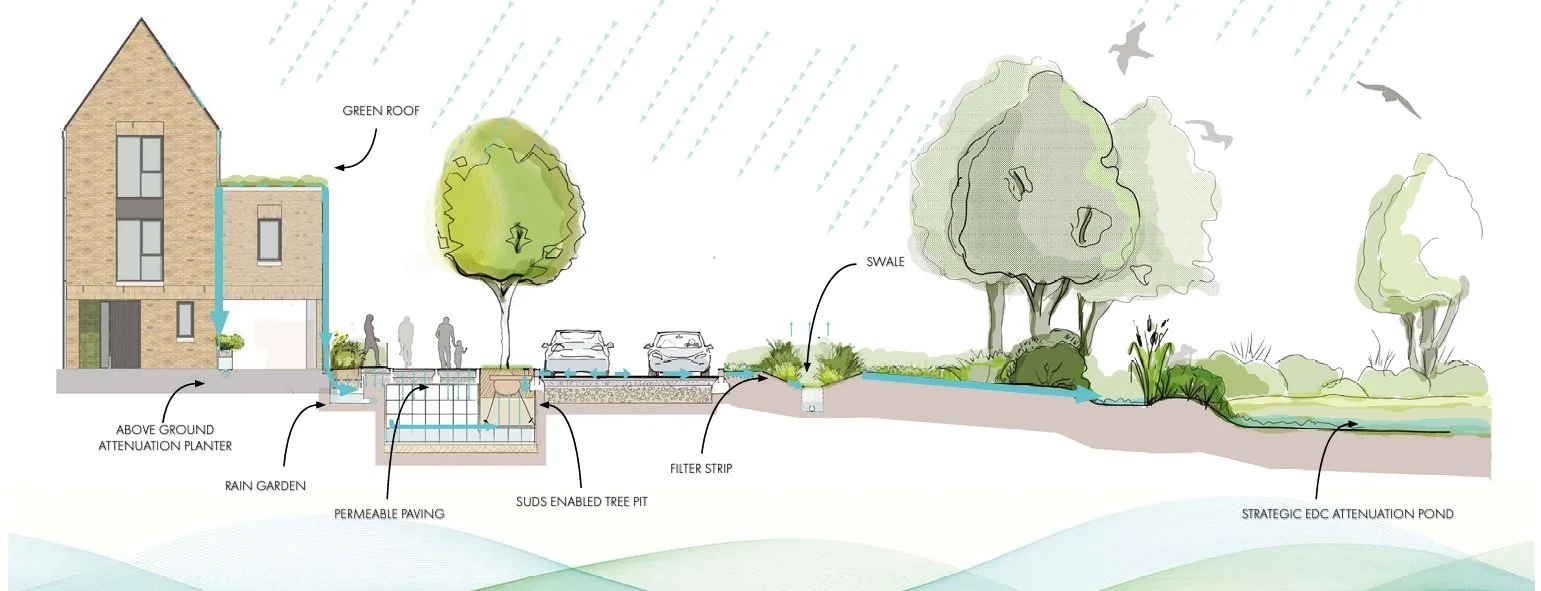
Linking SuDS interventions effectively is about creating a connected "train" of measures that manage water progressively across a site. Each element should support the next, starting with source control features such as green roofs, rain gardens or permeable paving to capture rainfall and hold it as close as possible to where it lands.

Conveyance features such as swales and filter strips then slow and guide the flow of surface water, whilst intermediate storage such as detention basins and bioretention areas provide capacity to the system to moderate the rate and volume of flow towards the end point. Finally, end features such as attenuation ponds or basins handle residual volumes before controlled discharge into the correct exit point.

The more comprehensive and effective the upstream SuDS measures are, the less reliance there is on large, deep, or visually intrusive attenuation features at the end of the system. By integrating SuDS within streetscapes, open spaces, and private plots, developers can achieve a drainage strategy that is resilient, attractive, and multifunctional-supporting biodiversity, amenity, climate resilience, and flood-risk management within a seamless, landscape-led approach.